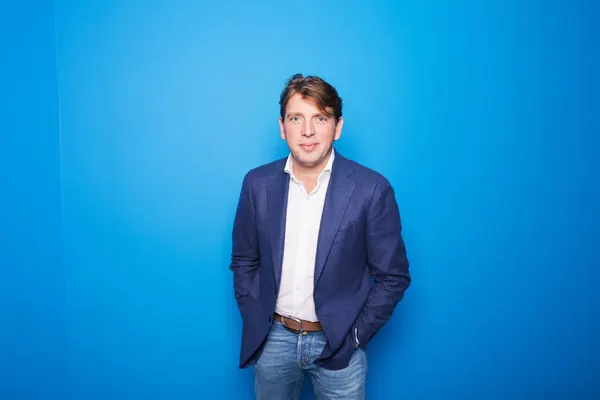
Everyone has a talent. A good leader knows the talents of their employees and coaches them so that they get even better at what they are already good at. "You don't ask a fish to fly either," says Kees Gabriëls. Together with Jan de Dreu, he wrote books including Handboek voor Talent (Handbook for talent). Managementboek
According to Kees, work engagement is three things. "First, doing what you are good at: using your talent. Second, you connect that talent to an ideal, preferably a sustainable mission or vision, and to practical goals with which you realise that vision. Third, you do it together. You can be engaged on your own and get far by yourself, but with a team you get further. By helping each other when things are tough, or removing a barrier to getting started, you are much more motivated to complete your task."
Remotely too
Even if you work together remotely a lot, little changes, Kees believes. "We are still working with other talents towards a goal and an ideal. Of course you sometimes miss the advantages of meeting in person, which is smoother, more intense and more subtle. But don't forget the advantages of working remotely. You can more easily meet more often and more briefly, especially across departments and companies. And at home you can work much more at your own pace, at least if your surroundings cooperate a little."
Managers: lead!
Kees believes in the right mindset. "It's about whether you see the advantages and want to make something of it. That also applies to managers. Do they want to focus on their own work, solving problems and making plans? Or do they focus on what is actually expected of them: leading? In my eyes, that means helping employees play to their strengths, encouraging cooperation and so helping them develop as much as possible. Turning a 7.5 into a 9. There is so much to gain there! With the right skills, you can really make the difference as a manager."
Gallup research also shows that the manager plays a big role: no less than 70% of the differences in engagement between teams are linked to the manager. Gallup
Don't overcomplicate it
"Sometimes it is made very complicated," says Kees. "To many team leaders or middle managers, a vision sounds complicated. A shame, because once your vision is clear, your team comes along as if by itself, and perhaps even becomes engaged. I once spoke to the team leader of an accounts department. His colleagues saw the financial reports as a look into the past, whereas he saw them as a look into the future. When his employees heard that, you could almost hear the penny drop. Suddenly there was a lively brainstorm. If that's the case, they said, we had better set up our reports differently. Wonderful, isn't it, what such an insight can mean for a team!"
Troubled by dragons
Besides a clear purpose and practical goals, Kees encourages a talent-driven way of working. "Every person is a talent, a team is a collection of talents and an organisation is a collection of teams. So organisational development is the sum of talent journeys," he explains. "That is why it is important to know your employees' talents and their 'dragons'. Those are beliefs such as 'I can't do it', 'I don't dare' or 'my parents don't like it'. Because of the dragon behaviour that goes with them, we drift further and further away from what we are good at, or what we enjoyed so much as children."
Observing gives insight
To discover everyone's talent, Kees says you can best observe your employees in silence for two weeks. "Note down all the small moments of success for each employee. Write down what went well and above all why, as far as you can see. Those notes are the basis for a good conversation. Give the employee a compliment and ask, for example, why he or she thinks it went so well, and whether he or she does that more often. That way you get to know your people's drivers and talents better and better."
Divide the tasks
Once it is clear what everyone's talent is, you can find tasks to match. Kees believes in splitting up work, with clearly agreed responsibilities. "A lot of work is done now because it has always been done that way, or because someone asks: who has time? It is better to look at who can do something best. For example, I am responsible for revenue, but I don't have a talent for all the tasks within that role. I would rather ask a colleague to come up with a corporate gift or make a cold call. By organising ownership well and helping each other from there, you make progress in an enjoyable way. Really good cooperation also means coaching each other: encouraging and being critical."
Only 'blue' didn't work
Kees didn't always work like this. "I started out very 'blue', very rational, because at Nyenrode you weren't taught back then how to get people on board. I got stuck on that. As CEO of Neckermann, I had to make the switch from print to digital with 700 employees. I wondered how I could turn 700 obstacles into 700 helpers. Jan de Dreu, with whom I later wrote a number of books, said: 'Never with your approach.' According to him, organisations are the effect and people are the cause. That hit like a bomb. I had always been treating symptoms!"
An inspiring place
Since then, it has been his mission to turn organisations into an inspiring place. "I feel in every phone call, every email and every meeting that this is what it's about. That together with a great team, with my talent for clarifying, I can contribute every day in my own way to the connection between people and business. Work is a potential source of engagement. Now that is what makes me engaged!"
Also read do you believe in your own abilities? and job crafting to stay engaged.
Sources