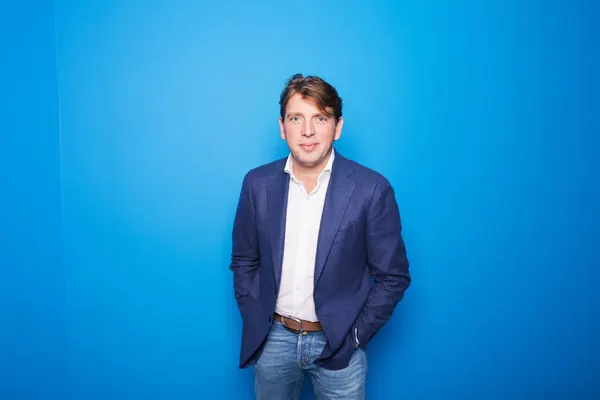

Engaged people get satisfaction from their work, are dedicated and feel energetic and proud. Work engagement also makes people more productive and innovative. But how do you stay focused? And what rhythm goes with that? Para-triathlete Sander Koomen knows all about it. His story is about the urge to perform and prove yourself, but above all about sustainable performance: not pushing yourself to the limit every day, but investing in a rhythm for the long term.
Who is Sander?
In 1993, Sander Koomen was diagnosed with Usher syndrome, a hereditary condition that affects hearing and sight. World Triathlon Even so, he refused to sit feeling sorry for himself in a corner. He started out as a rower, but found his real passion in triathlon. For years, he competed at the highest level in para-triathlon for blind and visually impaired athletes. UTMB He owes that in part to his engagement, iron discipline and resilience.
What came before
Before the Paralympic dream came into view, a lot had to happen. Living with a disability had taken its toll on Sander. He had become very good at hiding from the outside world how quickly his sight in particular was deteriorating. He himself crept further and further into the corner of the sofa. "Not only did I hear and see less, I was also making my world smaller and smaller. I was constantly on edge."
He was no longer functioning at work and went on sick leave. He also became isolated. His partner at the time shook him awake: this couldn't go on. He needed professional help.
Step by step
Sander ended up at Royal Visio, the Dutch centre of expertise for people with a visual impairment, to learn to live with the consequences of Usher. He spent a year in residential rehabilitation. "I learnt above all to look at the things you can do. That gives a much more positive feeling and focuses you on opportunities. And there are always opportunities, everywhere." He learnt to walk with a guide dog and a white cane, and was able to give his life meaning again.
Step by step, he discovered what he could do. "I certainly don't want to be 'that poor blind man', but to show everything that is possible." Looking for a new sporting challenge, he saw a campaign by NOC*NSF, the Dutch Olympic Committee, which was looking for Paralympic talent. Off to Papendal, the home of Dutch elite sport.
Nothing but positivity
The test day radiated positivity. So many people there wanted to show that they are more than their disability. That gave Sander an enormous boost. After the day, he received invitations from the rowing federation and the triathlon federation. In the end, triathlon felt best. Running was his strongest discipline, he still had a lot to learn in swimming, and because of his visual impairment he wasn't used to cycling fast. So he especially wanted to prove himself in the running sessions.
Breaking free from other people's expectations
As a newcomer to the group of para-athletes, Sander felt at home straight away. Working with other athletes, coaches and trainers towards the Paralympic dream: that was what he wanted to be part of. So he went all out in every training session. But instead of appreciation, he got criticism.
"I love putting on my running shoes and walking back into the garden completely shattered after three quarters of an hour. Exhausted but satisfied, I get in the shower. Ping, ping: a message from my coach. 'The assignment was to train in heart rate zones 1 to 2. Why did you go so hard?' Gone was the good feeling. I just wanted to show what I was capable of."
The route to the team's goal was not yet entirely clear to him. Together with the trainers and coaches, he had to work out what his role was, what was expected of him and what he needed to stay focused. "I learnt to look beyond the next training session or race. And perhaps even more important: I learnt to listen to myself and my body, without being weighed down by the expectations of those around me."
The rate of perceived exertion
Everyone has good days and not-so-good days. On good days, work or a training session seems effortless and even gives you energy. On other days, everything is an effort. It is not realistic to expect the same results then. To recognise those days, Sander's team works with the 'rate of perceived exertion' (RPE). That personal estimate of how much effort a physical or mental exertion costs you gives trainers and athletes a lot of information to tailor the training plan to.
"Working with this number increases the engagement between trainer and athlete, because we keep talking about it. After a session I say how hard it was, but beforehand I also say how I feel that day. As a result, the contact with my coaches has grown much stronger. I feel seen, and my input matters for performing sustainably in the long term. I don't have to be the best, the fastest or the strongest in every session. Every session is about the long term. Now that I know what a session means, I also get satisfaction from it."
What helps him most to keep up that rhythm is the feeling that people listen to him. Together with his coaches, he found a rhythm in which he can do one session a week at maximum speed. "Those hard sessions where I can really let loose are important for my self-confidence and well-being. That keeps me more balanced."
Speaking up in time
When an Achilles tendon injury threatened to spoil an important race, Sander noticed how much had changed. "In the past, I would have kept quiet and tried to live up to other people's expectations. After all, I don't want to disappoint anyone. But thanks to the better contact with my support team, I now manage to discuss this in time and come up with a plan together. Just as with the RPE, in the end I am the one who says what is and isn't possible, but the alignment provides a framework. That way, I make choices that are good for the long term, and not just for tomorrow's result."
His engagement only grows as a result. "Because we are clear about what we are working towards, we work together better and the atmosphere is even better. I always say: it's not what you are that limits you, but what you think you are not."
What helps Sander keep his focus and create rhythm?
- Asking for help. "Asking for help is not a sign of weakness, but of courage." At home, he makes clear agreements about the daily rhythm, and when he trains he doesn't let himself be distracted.
- Finding your own way. "There is no point in copying others. What works for one person doesn't have to work for another." When he tried to imitate successful para-athletes, he lost sight of the value of his own development.
- Starting with what goes well. "You learn from your mistakes, but it works much better if you first reflect on everything that is already going well." From that solid base, he and his trainers look at what could be even better, without a long list of points for improvement.
Do you recognise this in your own work? A good conversation about expectations, energy and rhythm works just as well in the workplace as on the athletics track. Also read focus for professionals.
About this article: this piece is based on a blog by para-triathlete Sander Koomen.
Sources