
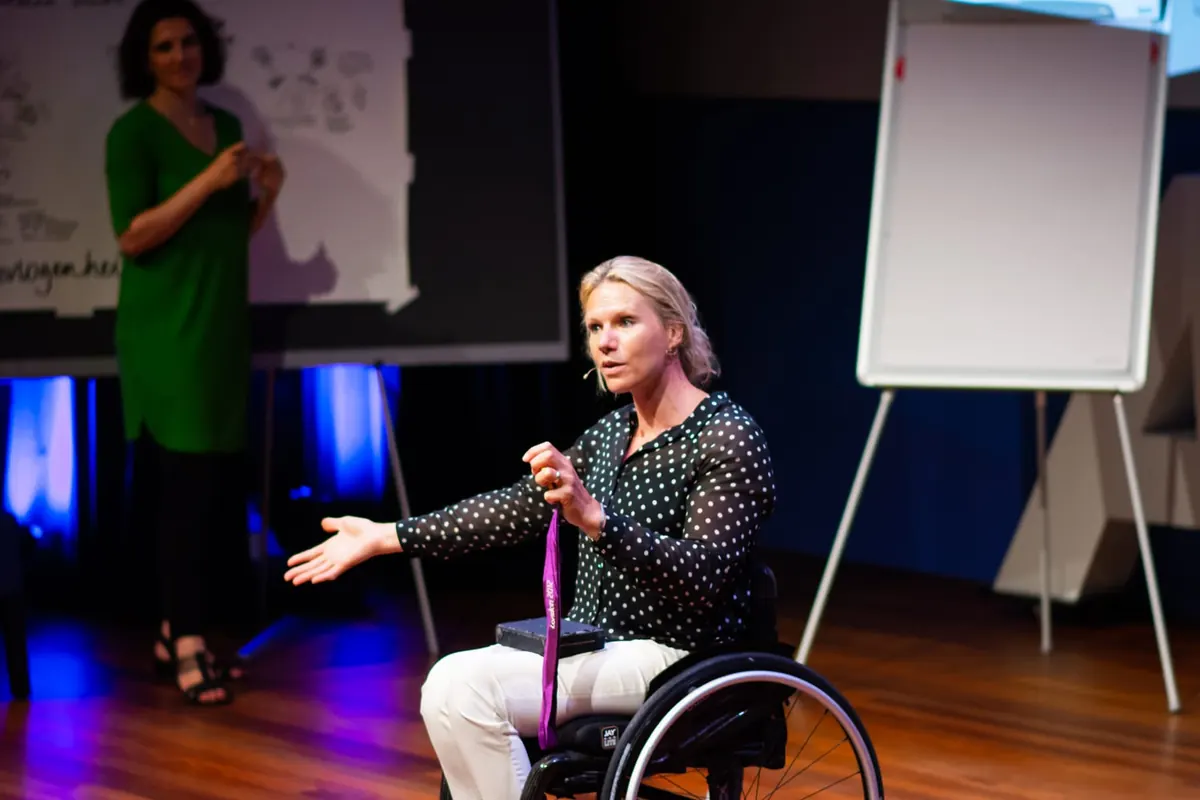
Esther Vergeer is one of the greatest Dutch athletes of all time. She became a seven-time Paralympic wheelchair tennis champion: four times in singles (2000, 2004, 2008 and 2012) and three times in doubles. In singles, she was unbeaten from January 2003 until her retirement. Wikipedia But her route to the top was anything but easy.
A setback at a young age
As a young girl, Esther had a brain haemorrhage. The cause turned out to be an abnormality of the blood vessels around her spinal cord. After an operation, she was left with a spinal cord injury and ended up in a wheelchair. Wikipedia
You don't wish for change, but it happens. According to Esther, the route chooses you, not the other way round. "After all, you know what it is like to be able to walk, move and get dressed. You become dependent on your family. PE was my favourite subject at primary school, and that made the first years very hard."
Through trial and error, Esther got to know life and herself at a young age. "What I can do and who I am." After a long rehabilitation, she kept going and took up tennis. She won a tournament with the resounding name of US Open. "Not to be compared with the US Open everyone knows, by the way," she jokes. "More like the club championships of the local tennis club."
Even so, she discovered a certain drive there. If I can win here, who or what is going to stop me? "Continuing to develop myself, that was my motivation to get the most out of myself every day. Getting better every day and helping disability sport forward. Every day a step closer to my ultimate goal: a gold medal."
Get the most out of yourself
A champion gets the most out of themselves, and so did Esther. "Only when you have to work under enormous pressure every day can you get the most out of yourself. But performing under pressure and getting the most out of yourself only works if you dare to open up and sometimes dare to ask others for help."
Visualisation
Visualisation helped Esther enormously. For years, before a match she could describe exactly what the stadium looked like, where her family were sitting, which changing room she was using and even where the Dutch flag would be raised. By visualising everything, she had a point on the horizon and could get to work with focus. Changes in circumstances therefore didn't make her panic: she already knew the situation.
A new goal after elite sport
Precisely because she liked to have everything under control, the step to stop was a big one. In February 2013, at the age of 31, she announced her retirement from tennis. Wikipedia "As an elite athlete, you are a control freak. Day in, day out your sport is all you think about and want to get the most out of yourself. The moment that falls away, you seem to fall into a big black hole."
"What makes me happy?" Finding a new goal after an elite sports career can be extremely hard. In her own words, it took Esther almost four years.
With the Esther Vergeer Foundation, which she set up in 2004, she helps children and young people with a physical disability or chronic condition to simply play sport, at an ordinary sports club, just like any other child. She is also tournament director of the international wheelchair tennis tournament in Rotterdam and has been chef de mission of the Dutch Paralympic team several times. Wikipedia New points on the horizon, with which she keeps getting the most out of herself and stays engaged.
Also read engaged heroes in sport and a little better every day.
Sources