For many years, Marien Groenendijk owned the family business Groenendijk Bedrijfskleding in Woerden, a one-stop supplier of workwear, safety shoes and personal protective equipment. Since 2025, the company has been part of the Lyreco Group. Groenendijk Bedrijfskleding Onbeperkte Denkers One of his biggest challenges as an entrepreneur: how do you keep adapting flexibly when the market is constantly changing?
"Writing a mission and vision for an organisation was already a chore during my studies," says Marien. "It always came across as a bit woolly: something you come up with once and that then disappears deep in a drawer. Or, slightly better, a text in the entrance hall that stays there for decades. When the trendy term purpose came along, I got the same feeling. Yet after a proper purpose session, I came to think differently about it."
Why purpose becomes more important as you grow
When you start a business, everything is still easy to oversee. You are on your own or your team is still small. What you want to achieve and why is well known in that small circle. But as a company grows and more layers are added, the goal is less and less top of mind for everyone. In the board and management team, you regularly talk about goals and strategy, but that doesn't always reach all employees.
Still, everyone needs to know which direction the company wants to go and what the core values are. Especially for growing organisations in a changing environment, it is important that everyone has the same goal in mind.
Whistling their way to work
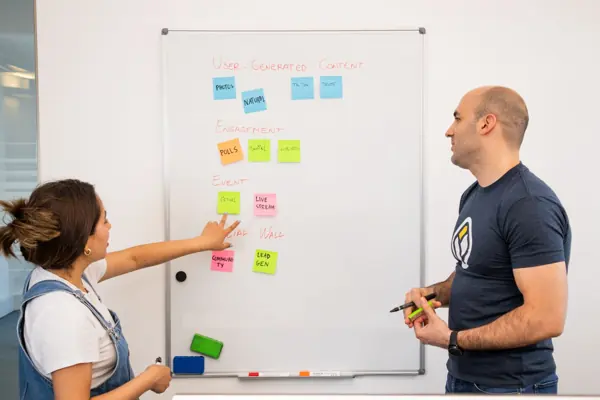
Marien did the purpose session with a mixed group of 'thinkers' from the company. Not just members of management, but also employees who look beyond the boundaries of their department. Guided by Paul van Heeringen, they mapped out the strengths and weaknesses of the organisation, and the challenges they were facing. After sharpening their field of work, they set themselves the goal of having both customers and employees 'whistle their way to work'.
By customers, they meant both the company and the contract manager, and the people who wear the clothing. "There is no hierarchy in that, but they each have their own dynamics."
Stay on course
You have to keep a purpose alive and evaluate it now and then. Do we still stand behind it? And how has the environment changed in the meantime? It worked well to set sub-goals in working groups and carry them out in short sprints, for example in a hundred-day challenge. Sharing the results with colleagues over a bowl of soup in the canteen, and communicating about them with customers, helped keep the purpose alive. To keep 'whistling your way to work' going in the long term too, it belongs in the HR policy.
The purpose makes decisions easier. You can keep asking: will our customer be happy with this? Will it make them whistle their way to work? And when there is a complaint, the returns department can ask itself: how do we make sure this wearer whistles their way to work again?
The company also made the purpose visible, with a large drawing in the canteen and a small version at the entrance. That way, everyone was constantly reminded of it. "It seems simple, but because you are confronted with your purpose again and again, you stay on course!"
Also read purpose: what is it, really? and how purpose makes people happier and pays off.
About this article: this piece is based on a blog by entrepreneur Marien Groenendijk.